The Murder of Giovanni Kalaberghi (Banbury, 1852)
Location: Williamscott, near Banbury, Oxfordshire, England
Year: 1852
In January 1852, an Italian man named Giovanni Brayelli Gullielmo Kalaberghi was executed by hanging in front of a crowd of upwards of 8,000 spectators.
Kalaberghi had been found guilty of the murder of his own uncle - also called Giovanni Kalaberghi - at Williamscott Hill (roughly 4 miles from Banbury).
Upon his arrest, he was initially "confined to a public house in Wroxton, with two constables with him at all times; however, Kalaberghi escaped, managing to run just over a quarter of a mile before the constable caught up with him! From then on, "he remained heavily ironed".
His trial was initially postponed, as the court sought to hire an interpreter; whilst awaiting the interpreter's arrival, the prisoner made a daring escape attempt. He threw himself from one of the prison windows, falling approximately twenty-five feet to the hard ground below, and sustaining some painful injuries (including breaking the fibula of his right leg) as a result.
The coroner's inquest into Kalaberghi Senior's death took place at The Crown Inn, Williamscott, the day after the murder; although it was obvious that the victim had been shot, the pistol in question was nowhere to be found, so the jury decided to reserve their judgement until more evidence could be gathered.
During the trial, with the aid of the interpreter, the defendant claimed that his uncle had been set upon by "three men, who had beaten him with great violence, and then shot him". He claimed that the assailants had then pursued him, but he had managed to outrun them.
It was very quickly revealed that Giovanni Junior had been seen purchasing the exact same style of pistol in Banbury a few days prior to the murder, and yet more incriminating evidence was discovered, too: the bullets used to kill his uncle had been hand-fashioned from a particular type of metal, making them very distinctive... Several bullets of that exact same type were found upon his person!
Upon examination of the body, it was confirmed that the deceased had died instantaneously, due to two bullet wounds: one to the back of the head, and another to the forehead.
Ms. Sophia Hobbs - housekeeper to the deceased - deposed that her employers' nephew had arrived from Italy roughly two or three months previously, and that he had resided with the deceased ever since. According to Ms. Hobbs, the prisoner had ran into the house on the evening in question at around 6 or 7pm, exclaiming:
"Uncle dead, uncle dead! Go, the priest! Priest, Italian!"
Ms. Hobbs had duly fetched the priest, who returned with her at once to the house. He and the defendant had conversed entirely in their native tongue for some time. She told the court that, whilst she had not witnessed any arguments between the two men, she knew that her master had suspected that his nephew was behind the disappearance of two expensive gold watches.
The deceased was apparently "much respected in the town, and was interred at the Catholic Church of St John, Banbury. A great number of sympathetic neighbours attended the funeral rites."
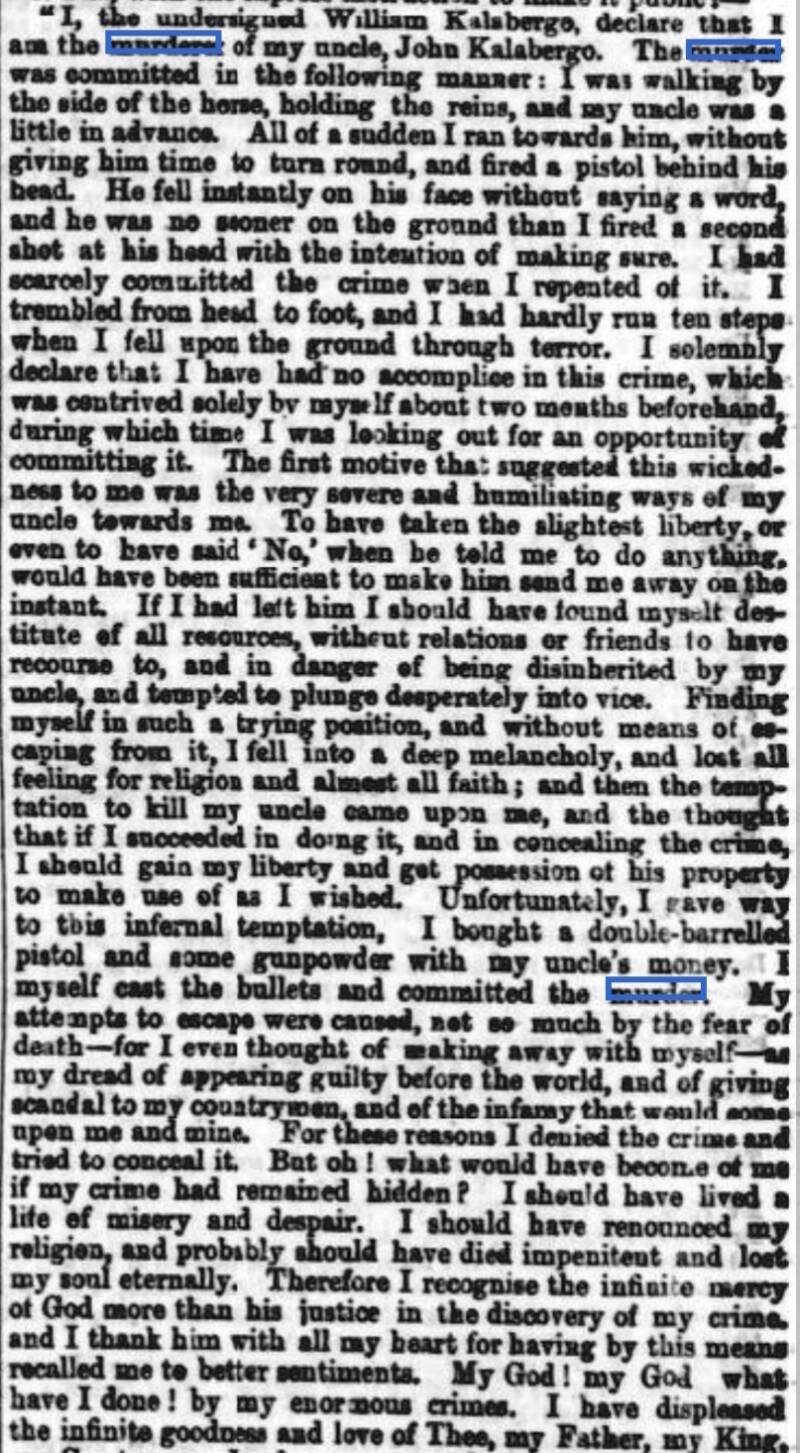
Eventually, Kalaberghi confessed to the priest whilst languishing in prison that he had indeed killed his uncle. His motive was pure greed - he had already stolen several valuable items from the deceased, depositing them in a freshly-dug grave in the Catholic cemetery in Banbury. He had hoped to inherit his uncle's property in the event of his death.
Giovanni Kalaberghi Junior was executed at Oxford Castle, appearing "very penitent and resigned to his fate. A few minutes after 8 o'clock that morning, the drop fell, and the culprit ceased to exist".
Following the execution, a written confession was published in various local newspapers (see below - image courtesy of the British Newspaper Archives, published in Bell's New Weekly Messenger, 28th March 1852).

Create Your Own Website With Webador